

BSL-2 microbiology lab · Bandung, Indonesia
Prove your antimicrobial product works
We test antimicrobial textiles, plastics, footwear, and building materials against internationally accepted standards, then give you an independent, certified report — from an IAC-certified laboratory (062-01-2021) that takes part in AATCC's PTP4 proficiency testing.
- IAC certificate 062-01-2021, renewed annually
- AATCC PTP4 antibacterial proficiency
- 7 international test methods
What we test
If your product claims to resist bacteria, fungi, or odor, we test whether that claim holds up.
-
Textile and apparel
Antimicrobial finishes on fabric and finished goods — socks, towels, uniforms.
-
Plastics and PVC piping
Plastics and pipe treated with an antimicrobial additive.
-
Medical footwear
Footwear made from PVC and EVA.
-
Ceramics and building materials
Surfaces treated to limit microbial growth.
How testing works
Three steps from sample to certificate.
-
Submit your product
Send us the material and tell us what claim you need to support. One email or call gets it started.
-
We test to the right standard
We match your product to the international standard that fits it (AATCC, ISO, ASTM, or JIS) and run the test in our BSL-2 lab.
-
Receive your certified report
A clear report and certification you can show customers, auditors, and procurement teams — 14–30 days, depending on the method and the current queue in the lab. We confirm the date when we accept the sample, before you ship anything.
Test methods
Every method gets its own page: what it measures, which organisms, what the report contains, and when a buyer asks for it. That's how a lab gets found.
| Method | What it measures | Typical products |
|---|---|---|
| AATCC 100Apparel, socks, towels, uniforms | Quantitative antibacterial finish performance on textiles | Apparel, socks, towels, uniforms |
| JIS L 1902Textiles for Japanese buyers | Antibacterial activity of textiles (Japanese standard) | Textiles for Japanese buyers |
| ISO 20645Woven, knitted, and other flat textiles | Antibacterial activity — agar diffusion | Woven, knitted, and other flat textiles |
| ASTM E3160Treated porous materials and textiles | Quantitative antibacterial assessment of porous treated articles | Treated porous materials and textiles |
| ASTM E3162Treated fabric, paired with AATCC 100 or JIS L 1902 | Durability of an antimicrobial finish to repeated laundering | Treated fabric, paired with AATCC 100 or JIS L 1902 |
| ASTM G21Plastics, building materials | Resistance of polymeric materials to fungi | Plastics, building materials |
| ASTM G29Films, outdoor materials | Algal resistance of plastic films | Films, outdoor materials |
Not sure which one your buyer wants? Tell us the claim and the market and we'll match the method before any sample ships.
Certifications
-
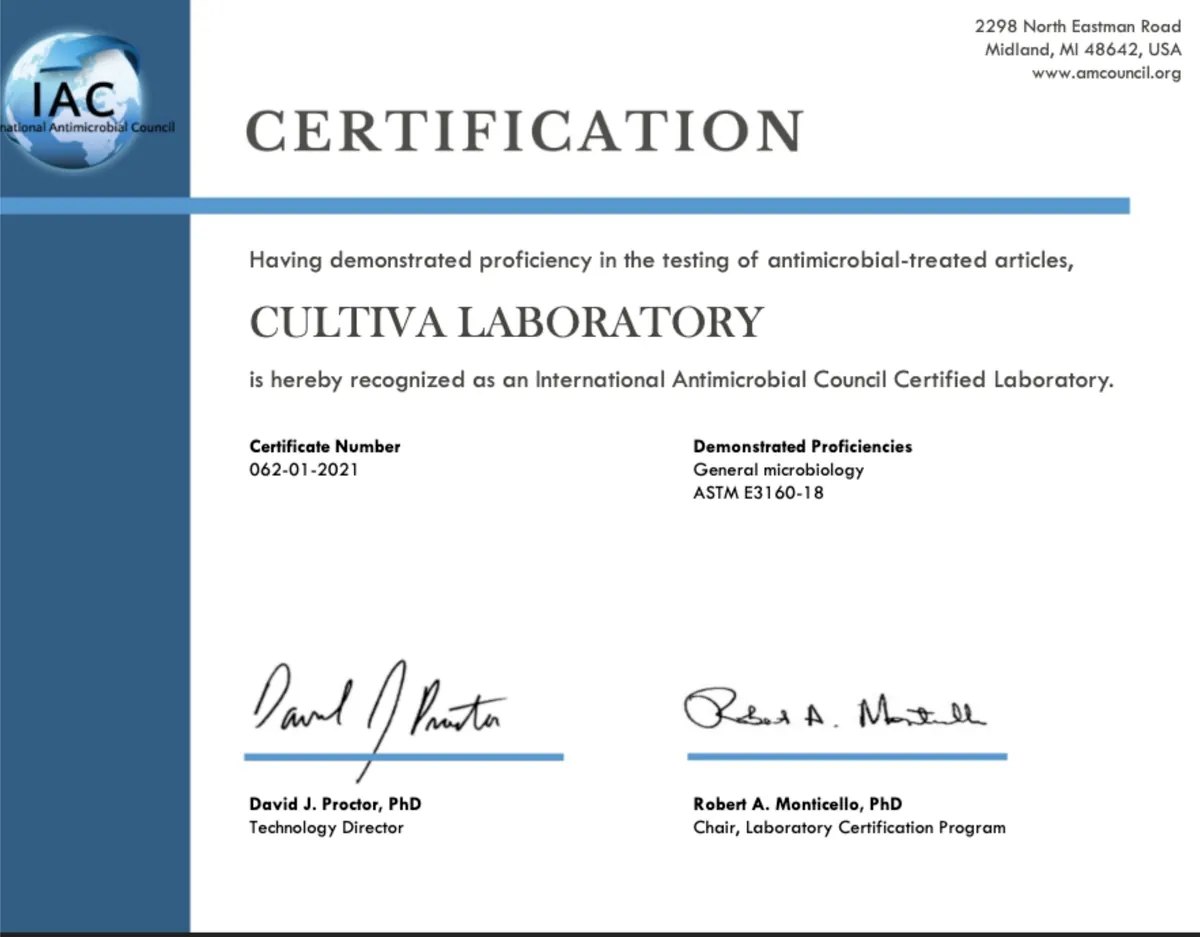
IAC Certified Laboratory (USA) Certificate 062-01-2021 · demonstrated proficiency in general microbiology and ASTM E3160-18 · authorized to use the IAC-APP mark -
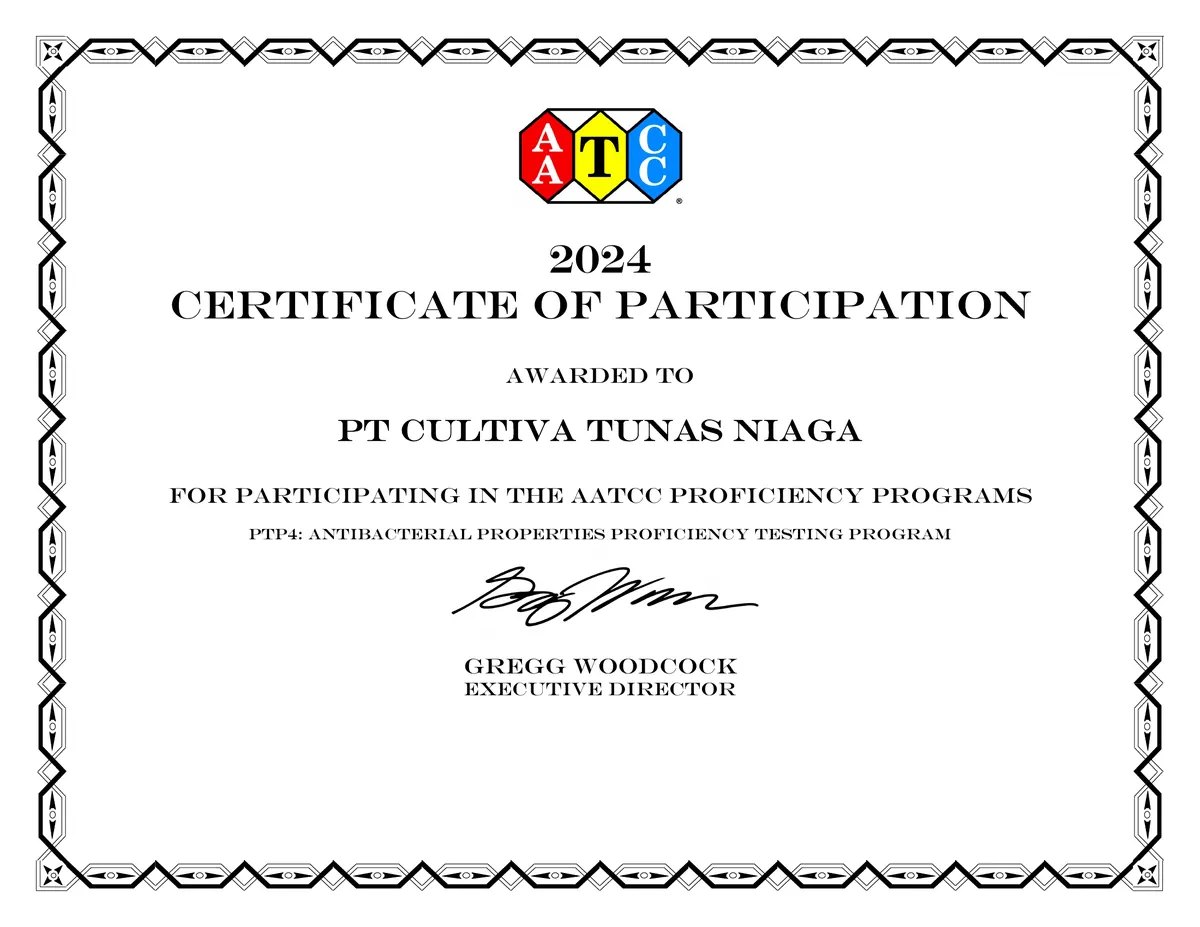
AATCC proficiency 2024 Certificate of Participation · PTP4: Antibacterial Properties Proficiency Testing Program


What you get back
An independent test report on Cultiva letterhead, carrying an IAC verification number your buyer can check. Here is what one looks like.
-
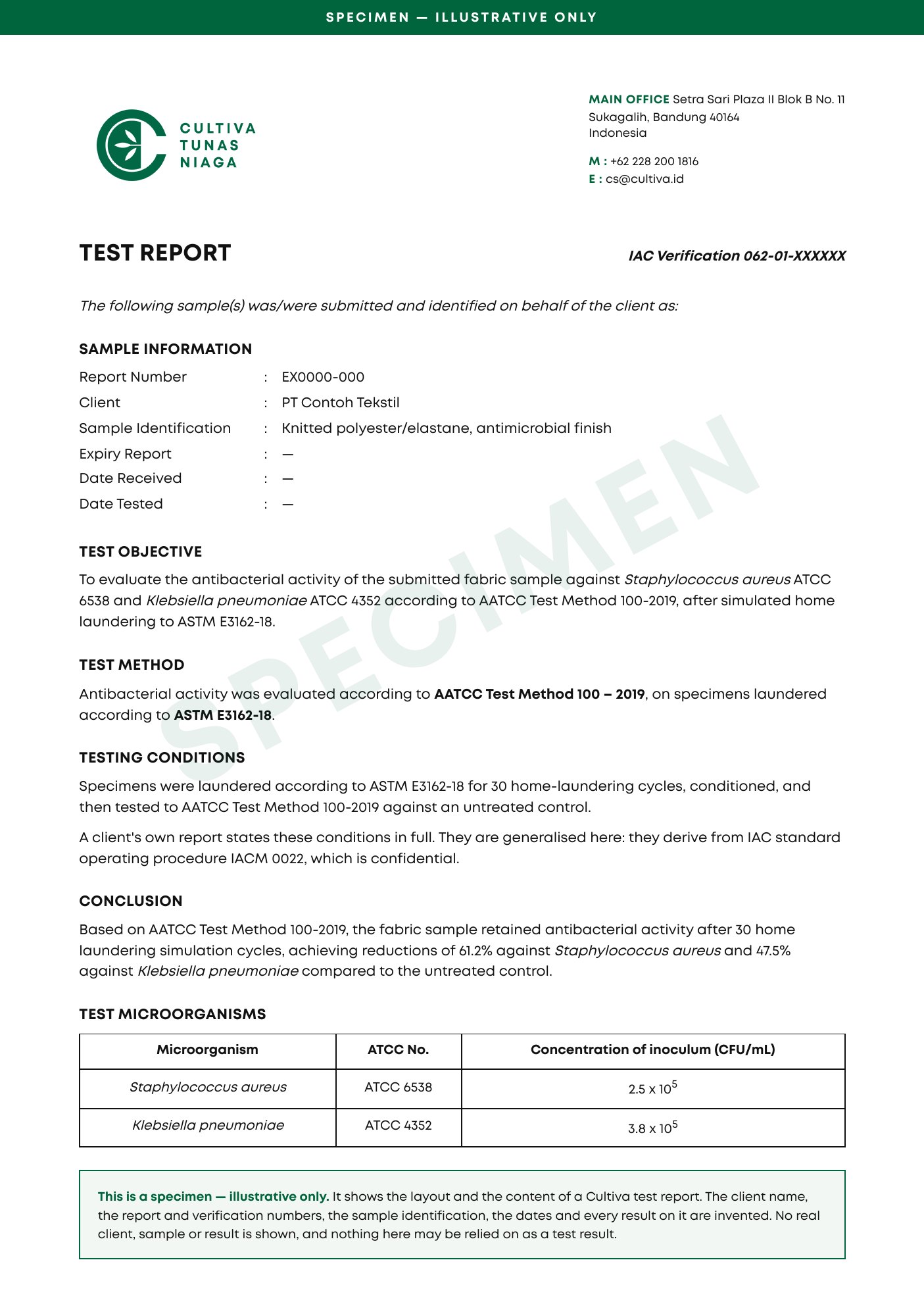
Page one: sample, method, conclusion What was submitted, which standards it was tested to, and the finding stated in one paragraph. -
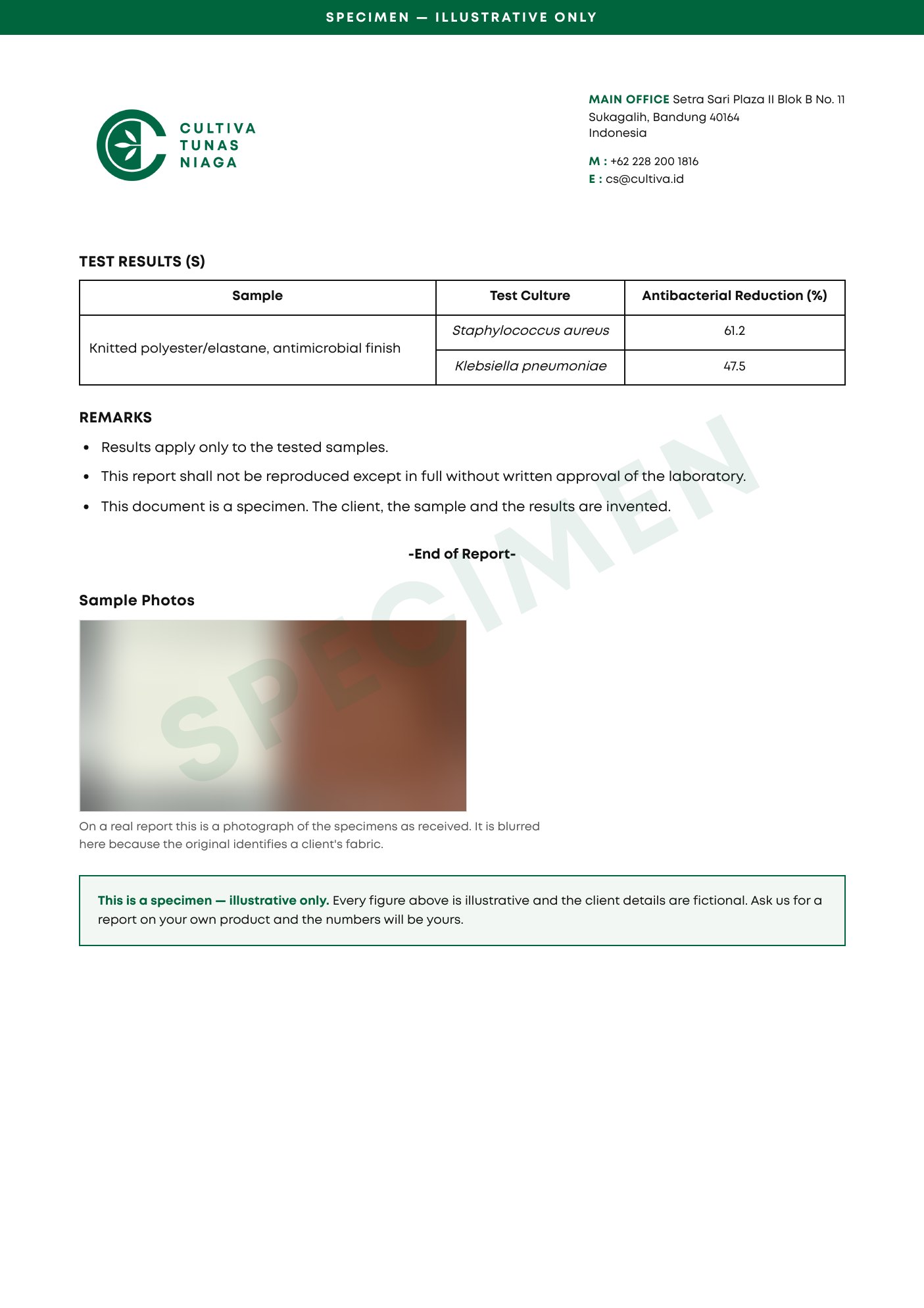
Page two: results, remarks, sample photographs The measured reduction per organism against the untreated control, the scope of the result, and photographs of the specimens as received.


This is a specimen and it is marked as one on every page: the client, the sample identification, the dates and every result on it are invented. Open the specimen report (PDF). Your own report carries your sample, your results and a verification number the buyer asking for it can check.
Ready to test your product?
Tell us what you're working on. We'll point you to the right standard and explain what the testing involves.